




Description
 View the original course outline
ESXLab’s vSphere 8.0 combined Study Guide and Lab Guide comes from our powerful 5-day class is an intensive introduction to VMware vSphere™ 8.0 including VMware ESXi™ 8.0 and vCenter™ 8.0. This course has been completely updated to reflect the most recent changes introduced in vSphere 8.0.
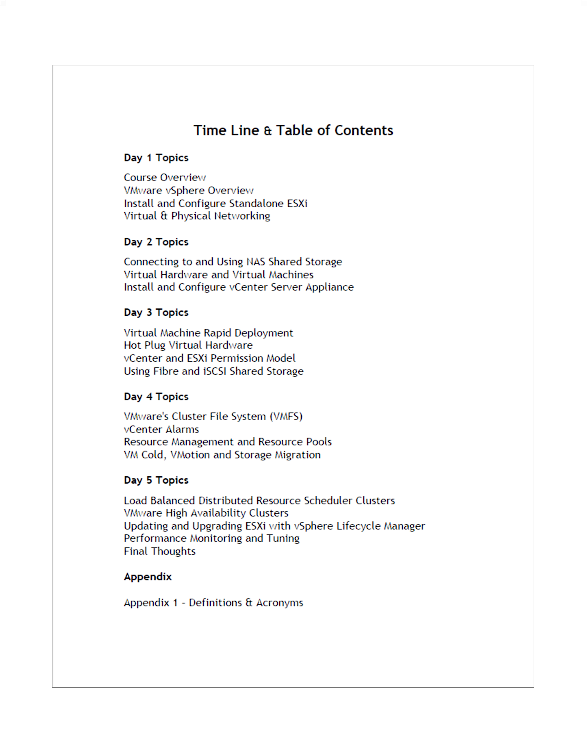
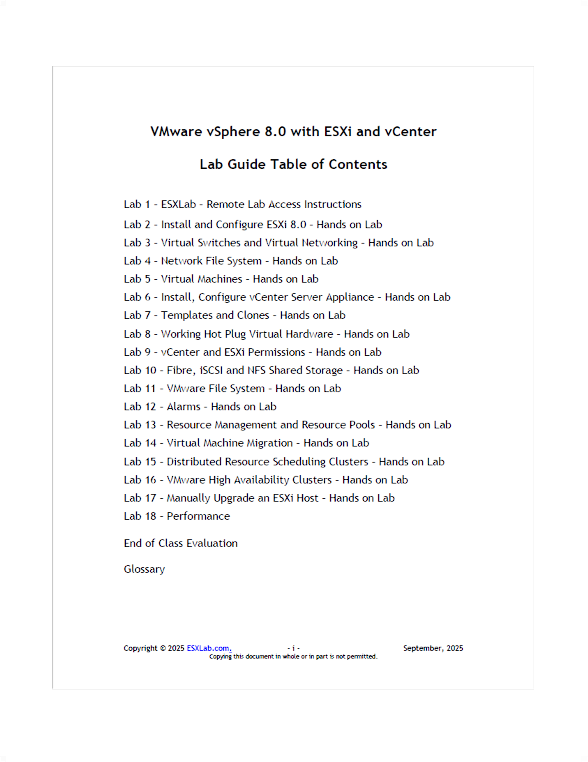
Assuming no prior virtualization experience, this class starts with the basics and rapidly progresses to advanced topics. It starts with the basic including installing, configuring and networking ESXi hosts. creating VMs, installing and configuring vCenter. It continues on by covering Virtual Machines, Permissions, storage, compute resource management, VM migration, building load balanced and failure recovery clusters, and more. Throughout the course best practices are provided, along with troubleshooting tips, and administrative short cuts.
For a more detailed look at our Study Guide and Lab Guide content, use the Look Inside link (above) to see the first 5 chapters. Or use the Download free sample link to review the first 5 chapters and four labs of this course.
Objectives
After working through our vSphere 8.0 Study Guide and Lab Guide, you will be able to:
- Explain the many significant benefits of virtualization
- Install ESXi 8.0 according to best practices
- Use Host Client to manage standalone ESXi hosts
- Configure and manage local storage resources
- Create virtual and virtual to physical network configurations
- Define and use file share (NAS / NFS) datastores
- Create and customize virtual machines
- Install, configure and upgrade VMware Tools
- Install, configure and administer vCenter Server Appliance
- Perform rapid VM deployments using VM Clones and Templates
- Use Guest OS customization to rapidly and consistently configure new VMs
- Configure and use hotplug virtual hardware to add VM hardware with zero downtime
- Add and grow VM virtual disks including system disks and secondary volumes
- Manually upgrade VM virtual hardware
- Use Permissions to enable and customize user and group access to vSphere
- Configure ESXi to connect to shared storage resources
- Create VMFS datastores
- Grow VMFS datastore capacity with LUN Spans and by Extending VMFS volumes and file systems
- Explain and use VMware’s three different multipathing policies – Round Robin, Fixed and MRU
- Use vCenter alarms to monitor ESXi, VM, storage and network health, performance, state
- Use Resource Pools to bulk delegate compute resource to VMs and child Resource Pools
- Perform VM cold migrations, hot VMotion migrations and hot Storage VMotion migrations
- Create VM Load Balanced DRS Clusters to dynamically balance VMs to Hosts to ensure compute resource availability
- Minimize unplanned VM down time with VMware High Availability clusters
- Update and Upgrade ESXi hosts using VMware Lifecycle Manager
- Use VMware Lifecycle Manager to upgrade VMware Tools and Virtual Hardware in VMs
- Monitor and tune both ESXi and virtual machine for best performance
- Troubleshoot common problems
- Use Best Practices to build a reliable, scalable and highly available vSphere environment
Reviews
There are no reviews yet.